
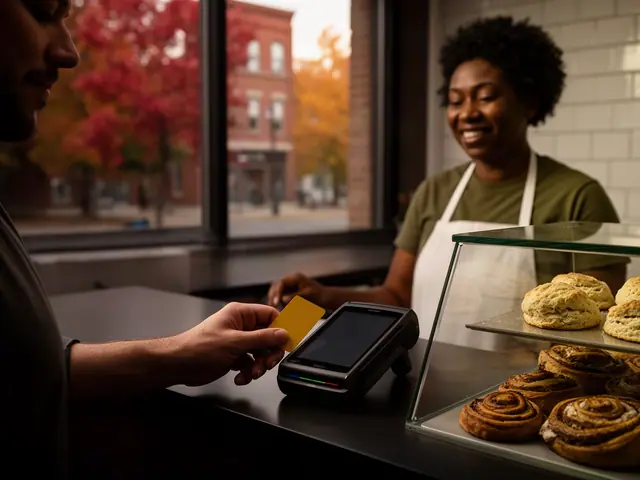

From Mount Pleasant, Michigan, Saltmead Funding Group routes card-sales advance requests to providers. This page explains factor rates and holdbacks, how an advance differs from revenue-based financing, and how to work out the total cost before signing. Throughout, the advance is treated as what it is, a purchase of receivables and not a loan.
At a glance
- Retail trade, Isabella County, MI
Retail stores, Isabella County, MI: 221 employer establishments (CBP 2023)
- Restaurants and other eating places, Isabella County, MI
Restaurants and other eating places, Isabella County, MI: 116 employers (CBP 2023)
- Offices of other health practitioners, Isabella County, MI
Chiropractic, therapy and other practitioner offices, Isabella County, MI: 31 employers (CBP 2023)
Revenue-based financing vs a merchant cash advance for Mount Pleasant, MI retailers
Both revenue-based financing and a merchant cash advance rise and fall with sales, yet the contracts work in different ways. Revenue-based financing is usually structured as financing that is paid back as a share of total revenue, often monthly, until a set cap is reached. A merchant cash advance is a purchase of future card receivables: the provider buys a share of card sales and collects it daily or weekly from settlements.
For a retailer, the practical difference is in the paperwork and in what happens in a slow month. Read whether the agreement calls itself a purchase or financing, how the share is calculated, and whether there is a reconciliation clause that adjusts collections when sales fall.
How does a merchant cash advance work for an Isabella County, MI therapy practice?
For a therapy practice that takes card payments for copays, cash-pay visits or retail products, a provider can buy a share of those future card sales. The practice receives the advance, the provider collects a holdback percentage from each card settlement, and collections stop once the agreed total has been remitted. Insurance payments are not card sales, so only part of a practice's revenue moves the collections.
That makes an advance a poor fit for a practice whose revenue is mostly insurance. Isabella County, MI had 31 offices of other health practitioners with paid staff in 2023 (County Business Patterns); for claim timing, the working capital page and credit lines are the closer match.
What a factor rate in an MCA means for Mount Pleasant, MI retailers
A factor rate is the multiplier that sets the total remitted on an advance. It is written as a decimal such as 1.2 or 1.35, not as a percentage, and it applies once to the whole advance. Because the total is fixed at the start, collecting it sooner does not lower it, so a short collection period can mean a high annualized cost.
Illustration only, invented figures: a $25,000 advance at a 1.32 factor rate means $33,000 remitted in all, or $8,000 above the advance, by our arithmetic.
The offer comparison article converts a factor rate and an interest rate to dollars, and the restaurant article sets an advance beside a credit line.
Is a merchant cash advance a loan for Isabella County, MI retailers?
No. Whatever an offer calls it, a merchant cash advance is not a loan. It is a sale of future receivables, so the retailer owes a share of card sales rather than a fixed loan balance, and the agreement is written as a purchase. Because it is not a loan, the costs are expressed as a factor rate and a holdback instead of an interest rate, which makes comparison with a loan offer harder.
The county's retail trade sector counted 221 employer establishments in 2023 (County Business Patterns, Isabella County, MI). A store comparing an advance with a loan should convert both to dollars: the advance's total remitted, and the loan's total of payments.
What a holdback rate means for Mount Pleasant, MI retailers with card sales
The holdback is the percentage of each day's card sales the provider keeps until the total has been remitted. If a retailer's holdback is set at 12% and its card sales one day are $1,800, the provider collects $216 that day (illustration only, invented figures). At that pace, $33,000 takes about 153 card-sales days to remit, by our arithmetic.
A higher holdback remits the total sooner but takes more of each day's cash; a lower one leaves more cash but stretches the period. Some agreements use a fixed daily or weekly amount instead, with a reconciliation clause that can adjust it to actual sales.
How to calculate a factor rate before a Mount Pleasant, MI therapy practice signs
To calculate the cost of a factor rate before signing, multiply the advance by the factor rate for the total remitted, subtract the advance for the dollar cost, and add any origination or administrative fees. Then estimate how many days collections will take at the holdback and the practice's average card sales.
Illustration only, invented figures: the $25,000 advance above costs $8,000 before fees. A $25,000 loan at an annual rate of 15% over 12 months would cost about $2,077 in interest, by our arithmetic. Lay both totals side by side and use the calculator for the loan side.
By Saltmead Funding Group · Updated